Compressed air demand inside an industrial facility is rarely perfectly constant. Pneumatic machines start and stop, valves operate, tools consume air intermittently, and production requirements change throughout a shift. An Air Receiver Tank provides storage capacity that helps a compressed air system accommodate these variations.
Understanding its role can help plant teams plan compressed air infrastructure more effectively.
What Does an Air Receiver Tank Do?
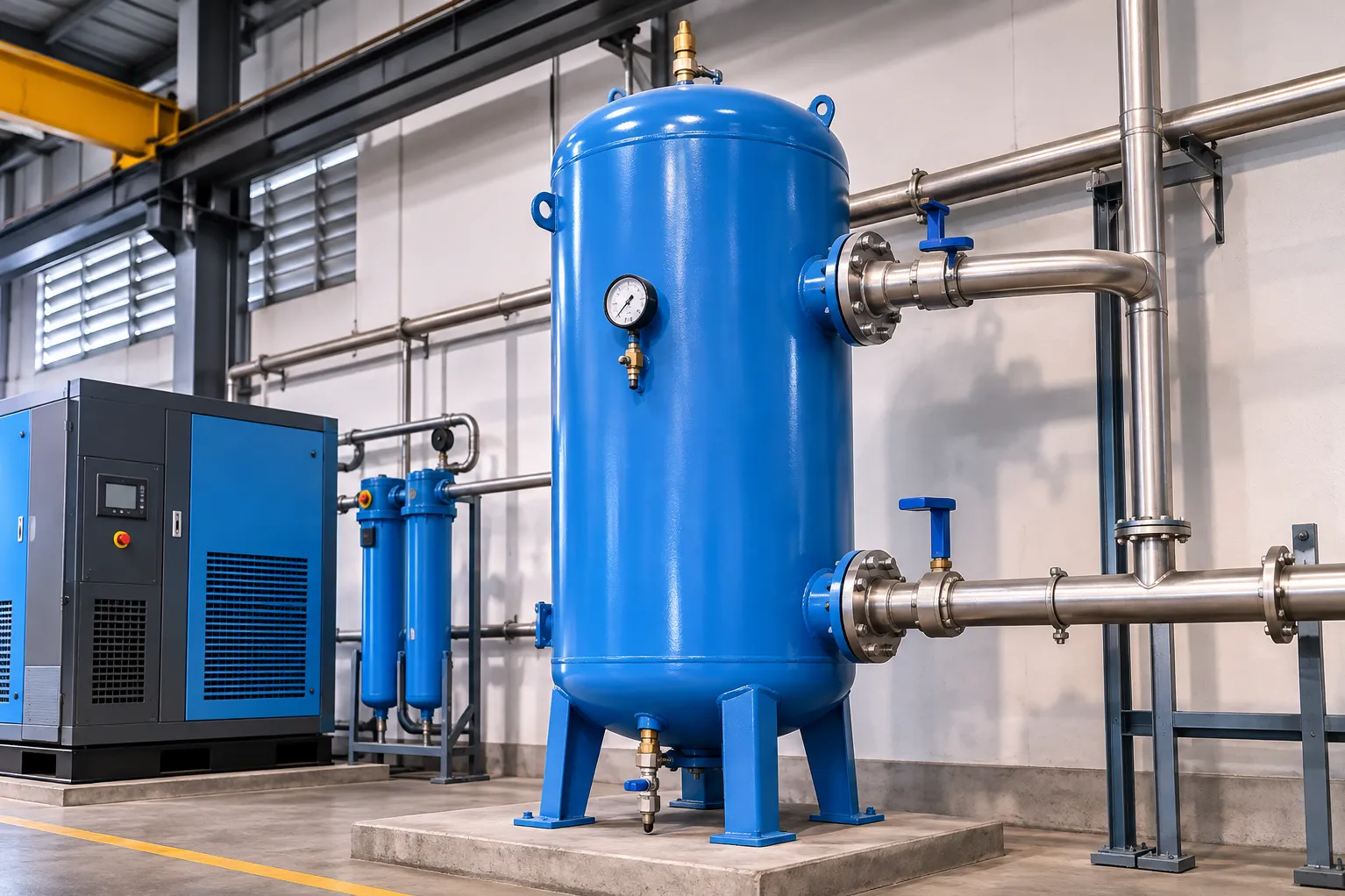
An air receiver stores compressed air produced by the compressor. This stored volume acts as a buffer between compressed air generation and fluctuating downstream consumption.
Depending on the system configuration, a correctly planned receiver can help with:
- Managing temporary demand fluctuations
- Providing compressed air storage
- Reducing rapid compressor cycling
- Supporting more stable system operation
- Allowing moisture to collect for drainage
- Accommodating short-duration peak demand
It should be considered as one part of the overall compressed air system rather than an independent accessory.
Why Air Demand Fluctuation Matters
Imagine a manufacturing line where several pneumatic devices operate simultaneously for a short period. Demand can rise quickly even if average consumption remains moderate.
Without sufficient system storage, the compressor and control system may need to respond more aggressively to these changes. Receiver capacity can help buffer short peaks, depending on system design.
This is especially relevant in engineering workshops and production facilities where pneumatic demand changes repeatedly during machining, assembly, fabrication, or packaging operations.
Receiver Size Should Be Engineered
Choosing a tank based only on available floor space or an arbitrary capacity can lead to poor system planning.
Sizing may depend on factors such as:
- Compressor capacity
- Operating pressure
- Air consumption pattern
- Peak demand
- Compressor control method
- Required storage time
- Downstream process requirements
A compressed air specialist or engineer can evaluate these variables to determine suitable receiver capacity.
Construction Requires Careful Attention
Because an air receiver contains compressed gas, its construction involves pressure-related engineering considerations.
Material selection, shell thickness, welding quality, nozzle arrangement, supports, inspection requirements, and applicable design criteria must be addressed appropriately.
Procurement teams should therefore avoid treating an air receiver as an ordinary storage tank.
Installation Details Affect Practical Operation
The receiver's position within the compressed air system depends on the intended system arrangement. Accessibility is also important.
Operators and maintenance teams may need access to:
- Drain points
- Pressure indication
- Safety-related fittings
- Isolation arrangements
- Inspection openings
- Connected piping
Moisture management deserves particular attention because compressed air systems can generate condensate. Suitable drainage provisions can simplify routine operation.
Inspecting Existing Receivers
Air receivers should not disappear into the background after installation.
Plants should establish inspection and maintenance practices appropriate to their equipment and applicable requirements. Visible corrosion, damaged supports, leakage, abnormal pressure behaviour, or deterioration of associated components should receive attention rather than being ignored until failure occurs.
Maintenance requirements should be incorporated into the facility's broader compressed air management program.
Industrial Requirements in Maharashtra
Nagpur and other industrial areas of Maharashtra include fabrication workshops, manufacturing facilities, process plants, and infrastructure-related operations where compressed air is routinely used.
When custom fabrication is involved, working with an engineering manufacturer that understands industrial equipment requirements can support better coordination between drawings, manufacturing, inspection, and site installation.
Ghude Engineering, based in Nagpur, operates within this heavy fabrication environment and handles engineered equipment requirements for industrial applications.
An air receiver tank ultimately performs a simple but important function: providing stored compressed air within a properly designed system. Its value, however, depends on correct sizing, appropriate construction, suitable installation, and disciplined maintenance.
Treating the receiver as engineered pressure equipment rather than an ordinary tank is the right starting point for safer and more reliable compressed air infrastructure.
Keywords