A quotation such as “500 L, 10 bar” leaves out the pressure-vessel details that determine safety, usable air capacity, corrosion life, and compliance. By the end, you will have a practical specification, sizing method, material choice, fitting schedule, and document checklist to send to suppliers before fabrication begins.
Key takeaways
- State design pressure, working pressure, temperature, volume, material, and test requirements.
- Size the receiver against compressor output, demand fluctuations, and acceptable pressure drop.
- Choose MS for economical dry air service; specify SS for corrosion-sensitive applications.
- Demand drawings, material certificates, test records, and statutory documents before dispatch.
The Specification Data Your RFQ Must State
Your RFQ must define the complete vessel, not just capacity and pressure. “500 L, 10 bar” is incomplete because 10 bar could mean working or design pressure, while the plate grade and test method remain unknown.
| Field | State in the RFQ | Why it matters |
|---|---|---|
| Receiver volume | Nominal volume in litres | Fixes the vessel size |
| Pressure | Working pressure and design pressure in barg | Set design pressure above maximum operating pressure |
| Temperature | Operating and design temperature in °C | Controls material and design limits |
| Arrangement | Vertical or horizontal; allowable vacuum condition | Confirms fit and structural suitability |
| Construction | Shell and head thickness, corrosion allowance | Prevents under-specified pressure boundaries |
| Material | Grade and standard, such as pressure-vessel plate; identify 304L or 316L for stainless steel | “MS” and “SS” are not material specifications |
| Connections | Nozzle sizes, orientations, drain, gauge, safety-valve and inspection opening | Matches piping and maintenance access |
| Compliance | Construction code, inspection authority and pressure-test method | Defines fabrication, examination and acceptance |
| Finish and records | Coating or lining, plus drawings, calculations, material certificates, weld and NDT records, test certificate, calibration certificate and nameplate data | Creates a traceable handover dossier |
Coordinate design pressure with compressor cut-out, pressure-switch tolerance, safety-valve set pressure and downstream regulators. Do not permit an operable isolation valve between the vessel and relief valve unless the governing code allows the arrangement.
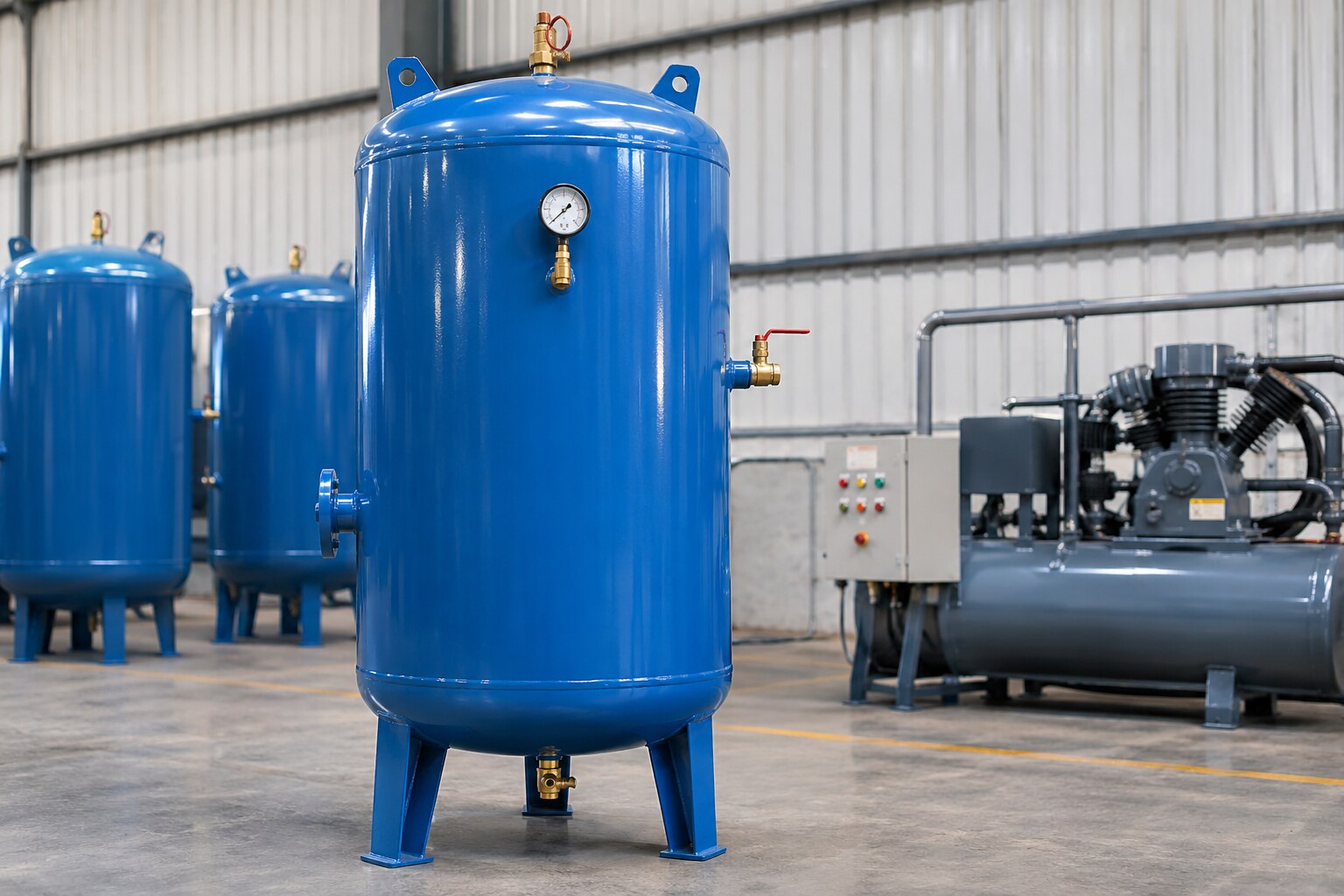
Before approval, demand a general arrangement drawing showing overall height, diameter, supports, anchors, lifting lugs, drain location, inspection opening and nozzle schedule. These fields form the core of useful air receiver tank specifications.
How to Size the Receiver for Real Plant Demand
Size the receiver from free-air delivery and plant demand, not compressor horsepower. Gather these inputs before selecting volume:
- Compressor free-air delivery in CFM or m³/min
- Intermittent peak demand and its duration
- Allowable pressure band
- Compressor control method, such as load/unload, modulation, or start-stop
- Required pressure ride-through time
For a receiver discharging without compressor contribution, use V = Q × t × Patm ÷ (P1 − P2). Use absolute pressures and consistent units; with Q in m³/min and t in minutes, V is in m³.
A vessel falling from 10 barg to 8 barg has a 2 bar difference and supplies about 1.97 receiver-volumes of free air because atmospheric pressure is approximately 1.013 bar. A nominal 1,000 L tank therefore delivers about 1,974 L of free air across that band, not 1,000 L.
| Receiver role | What it does | Main sizing concern |
|---|---|---|
| Buffer | Covers short load peaks | Peak flow and duration |
| Cycling control | Extends compressor run time and reduces starts | Control mode and minimum run time |
| Wet | Collects condensate before the dryer | Drain capacity and access |
| Dry | Stores treated air after the dryer | Required clean-air ride-through |
Confirm the result against sustained demand and distribution-pipe pressure drop; a large tank cannot fix an undersized header. State these air receiver tank specifications in the RFQ, then ask a compressed air receiver tank supplier to verify the calculation against the compressor’s actual duty cycle.
Choosing MS or SS for the Pressure Boundary
Choose mild steel for ordinary plant air when you control condensate, limit contamination, and can maintain an external coating. Your air receiver tank specifications must name pressure-vessel plate grade and material standard, corrosion allowance, coating system, and weld requirements; weldability alone does not make IS 2062 structural steel suitable for a pressure boundary.
| Option | Material decision | When it applies |
|---|---|---|
| MS | Pressure-vessel plate, internal corrosion allowance, external coating | Controlled condensate, ordinary plant air, manageable contamination, and lower fabrication cost |
| 304 or 304L | Stainless pressure boundary without an internal coating | Clean service, low-chloride condensate, wash-down, and process areas |
| 316 or 316L | Higher resistance to chloride exposure and aggressive cleaning chemicals | Chloride-bearing moisture or cleaning chemistry that makes 304 unsuitable |
Stainless steel adds material, specialised welding, fabrication, finishing, and inspection cost. It does not guarantee immunity: chloride-bearing water can pit stainless steel, so select the grade from condensate analysis and cleaning chemicals rather than the label “SS.”
For an ms ss air receiver tank comparison, request these items before approving a quotation:
- Plate certificates with heat numbers and the stated material standard
- Welding procedures, welder qualifications, and weld-map and NDT records
- Internal finish, cleaning method, and cleanliness acceptance criteria
- Corrosion allowance, coating details, and pressure-test documentation
A supplier who writes only “MS” or “SS” has not completed the material specification.
Selecting Orientation, Connections, and Condensate Controls
Choose a vertical receiver when floor area is limited, a bottom drain is useful, and condensate needs a clear path. Choose a horizontal receiver when headroom is restricted or transport, support, and maintenance access favour a lower vessel.
| Option | What it means | When it applies |
|---|---|---|
| Vertical | Smaller footprint, bottom drain, greater installation height | Limited floor area and straightforward condensate collection |
| Horizontal | Lower height, broader support base, easier handling in some layouts | Restricted headroom, transport constraints, or easier access at floor level |
Before approval, check installation height, lifting method, inspection clearance, anchor loads, wind or seismic effects where relevant, and connected-pipe nozzle loads. Design the supports for the full water-filled hydrotest weight, not only the empty vessel.
Your air receiver tank specifications should identify each connection and its purpose. Give the compressed air receiver tank supplier these requirements:
- Spring-loaded safety relief valve connected directly to the vessel, with no operable isolation valve unless the code-compliant arrangement prevents isolation during service.
- Calibrated pressure gauge, pressure-switch connection, inlet and outlet nozzle sizes and orientations, and an isolation valve.
- Low-point automatic or manual drain, with sloped piping and access for clearing rust, oil, or scale.
- Inspection opening sized for the vessel diameter and governing code, plus lifting lugs.
- Wet receiver downstream of the aftercooler and moisture separator for condensate collection, or dry receiver downstream of the dryer for treated-air storage.
- Automatic drain for routine water removal; retain inspection, an oil-water separator, and approved condensate disposal for oil-lubricated compressors under Indian pollution-control rules.
What to Demand from Nagpur Suppliers Before Dispatch
Compare quotations by locking the code, inspection route, and evidence before fabrication—not by comparing “500 L, 10 bar” against another “500 L, 10 bar” offer. Name ASME Section VIII, Division 1, or the applicable Indian pressure-vessel requirements in the purchase order, and identify the inspection authority before work starts.
| Criterion | Quote to accept | Clarify or reject |
|---|---|---|
| Construction | Named code, material standard, design pressure and temperature | “Designed as per standard” with no code |
| Inspection | Named authority, hold points and statutory route | Inspection offered only after fabrication |
| Delivery evidence | Complete dossier and installation drawings | Generic fabrication certificate or hydrotest certificate alone |
Request these records before dispatch:
- Design calculations, including shell and head thickness, corrosion allowance, and allowable vacuum conditions.
- Pressure-vessel material test certificates with heat numbers traceable to the shell and heads.
- Welding procedure specifications, welder qualifications, weld maps, and non-destructive examination records.
- Hydrostatic or approved alternative pressure-test certificate, plus safety-valve calibration certificate.
- Coating data, internal-cleanliness confirmation, preservation details, and the final nameplate photograph.
Check that every document matches the vessel volume, design pressure, design temperature, material, serial number, and recorded test results. Registration or inspection requirements can change with the installation state, service, and site arrangement, so confirm them with the authority before ordering.
Obtain the nozzle-orientation drawing and foundation loads before delivery. When comparing an air receiver tank manufacturer in Nagpur, assess whether Ghude Engineering can turn these requirements into traceable fabrication records and an installation-ready vessel, as you would with any compressed air receiver tank supplier.
This is the practical standard for comparing air receiver tank suppliers and manufacturers in Nagpur.
Frequently asked questions
What should an air receiver tank RFQ specify?
State the vessel volume, design pressure, working pressure, design temperature, air quality, plate material, corrosion allowance, nozzle sizes, orientation, supports, drain arrangement, inspection, and pressure-test requirements.
How do you size a compressed air receiver tank?
Use compressor output, peak and average plant demand, pressure-band limits, compressor control method, and the required ride-through time. Check the result against pressure drop and cycling frequency rather than choosing capacity from a nominal tank label.
Should you choose an MS or SS air receiver tank?
Choose MS for cost-effective service when condensate is controlled and the internal coating or corrosion allowance suits the air system. Choose SS when moisture, process contamination, or product-contact cleanliness makes carbon steel unsuitable.
What condensate controls should an air receiver have?
Specify a low-point drain, accessible drain connection, isolation valve, and a manual, timed, or zero-loss automatic drain that matches the condensate load. Provide safe discharge routing and enough clearance for maintenance.
What documents should Nagpur suppliers provide before dispatch?
Request the approved general arrangement drawing, design calculations, material test certificates, weld and inspection records, pressure-test report, nameplate details, safety-device certificates, coating records, and applicable statutory approval or registration documents.
Keywords