

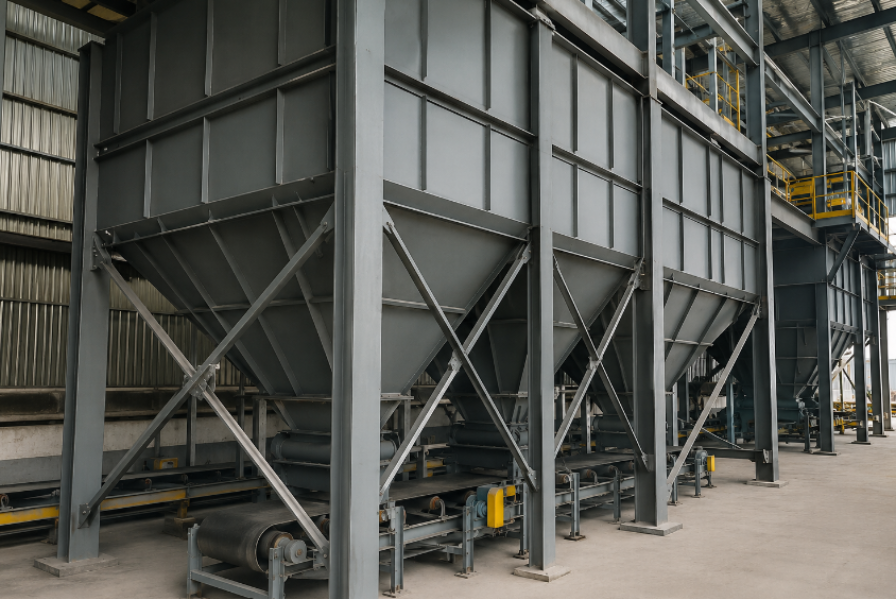
A hopper has a simple purpose: receive material and discharge it where required. In practice, poorly planned Hoppers can become persistent bottlenecks in industrial material-handling systems.
Bridging, inconsistent flow, excessive wear, material accumulation, difficult maintenance, and unsuitable discharge geometry can all affect plant performance. Choosing the right hopper therefore requires understanding both the material and the surrounding process.
Start With the Material Characteristics
Before requesting fabrication, define what the hopper will handle.
Relevant characteristics can include:
- Bulk density
- Particle size
- Moisture content
- Abrasiveness
- Flow behaviour
- Material temperature
- Tendency to stick
- Required storage volume
Two hoppers of identical capacity may require different geometries and construction details when handling different materials.
Define the Required Capacity Correctly
Capacity should reflect how the hopper interacts with upstream and downstream equipment.
A hopper feeding a continuous production process may require different buffering capacity from one receiving intermittent batch loads.
Procurement teams should provide expected material throughput and operating pattern instead of requesting capacity without process context.
Evaluate Inlet and Outlet Arrangements
Hopper performance depends heavily on how material enters and leaves.
The inlet should suit the feeding equipment, while the outlet must integrate correctly with equipment such as feeders, conveyors, chutes, or other process machinery.
Incorrect interface dimensions can lead to extensive site modifications.
Consider Wear Protection
Abrasive bulk materials can gradually damage hopper surfaces, particularly in areas exposed to repeated impact or high material velocity.
Depending on the application, engineering teams may need to consider suitable material thickness, replaceable wear provisions, or other protective arrangements.
These decisions should be made according to actual operating conditions rather than applying the same construction to every application.
Plan for Maintenance Access
Plant operators eventually need to inspect and maintain the hopper.
When evaluating a supplier's design, check whether relevant areas can be accessed safely and practically according to the system's maintenance requirements.
Maintenance planning becomes especially important for large industrial hoppers integrated into elevated structures or complex material-handling systems.
Check Structural Integration
A hopper containing bulk material can impose substantial loads on its supports.
Supporting structures, load transfer, connection points, surrounding equipment, and installation arrangement need to be coordinated. The hopper should therefore be treated as part of the overall plant structure and material-handling system.
What to Send a Manufacturer Before Ordering
A well-prepared hopper enquiry should include as much of the following information as possible:
- Material handled
- Required capacity
- Bulk density
- Inlet dimensions
- Outlet dimensions
- Overall space limitations
- Support arrangement
- Equipment interfaces
- Operating temperature
- Surface or wear requirements
- Drawings where available
- Installation location
Providing these details enables a manufacturer to develop a more relevant technical proposal.
Supplier Capability Matters for Custom Hoppers
Industrial hoppers frequently require project-specific fabrication rather than catalogue selection.
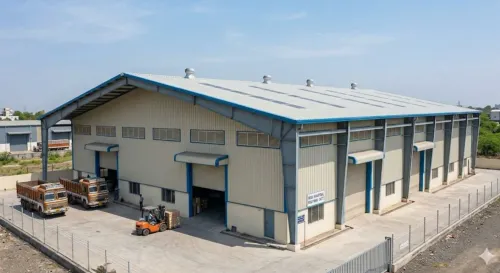
For steel plants, process facilities, EPC projects, and manufacturing units in Nagpur and elsewhere in Maharashtra, supplier evaluation should therefore consider drawing capability, heavy fabrication infrastructure, dimensional control, welding, material handling, and coordination with associated structures.
Ghude Engineering provides heavy engineering and fabrication solutions from Nagpur for customized industrial requirements, including equipment that forms part of larger plant systems.
The best time to solve hopper problems is before fabrication begins. When material characteristics, capacity, geometry, wear, equipment interfaces, structural loads, and maintenance access are evaluated together, the finished hopper has a better chance of supporting reliable material flow rather than becoming a recurring operational constraint.